
Disciplina de interpretación y auditoría de motores
A practitioner-grade checklist for validating calculation output, reviewing warnings, and turning technical data into credible guidance.
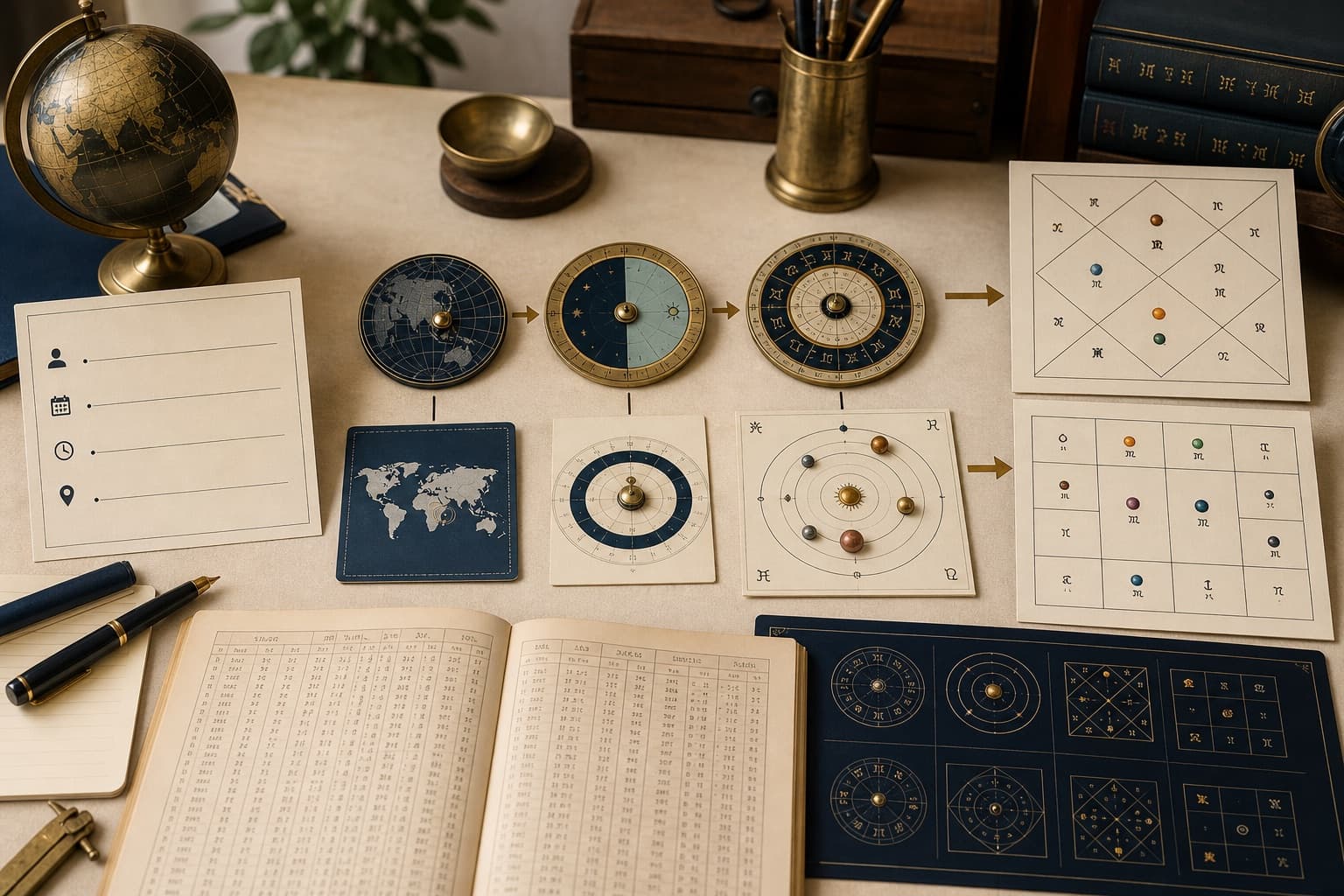
cuaderno visual
Cómo estudiar esta lección
Lea el concepto, mapéelo en un Kundli real y luego pruebe si la conclusión se deriva de la evidencia gráfica.
Entradas
paso 1Cálculo
paso 2Pantalla
paso 3receta de lectura
- 1La lista de verificación de auditoría
- 2Escalera de evidencia
- 3Niveles de confianza
- 4Lo que el motor no debe hacer.
Conceptos para reconocer
Disciplina estudiantil
No memorices esto como una predicción fija. Úselo como método: identifique el factor, verifique la condición, compare las capas de soporte y luego escriba una respuesta útil.
La lista de verificación de auditoría
Before making any reading claim, verify the calculation frame.
- Birth date, local time, timezone, latitude, and longitude.
- Whether birth time is exact, approximate, or unknown.
- Ayanamsa name and ayanamsa degrees.
- House system used for the report.
- Lagna sign and degree.
- Moon sign, nakshatra, and pada.
- Current Mahadasha and Antardasha.
- Calculation warnings, missing values, or boundary cases.
Escalera de evidencia
Interpretation should move from evidence to meaning. For example: Saturn is in Taurus in house 5; Saturn rules houses 1 and 2 for Capricorn Lagna; Venus hosts Saturn; current dasha may or may not activate Saturn. Only after this evidence should the reading discuss discipline around creativity, children, learning, speech, or resources.
This prevents generic AI output. A premium reading should show the user why it says what it says.
Niveles de confianza
Confidence is not a marketing label. It should reflect data quality and factor agreement. Exact birth time, repeated D1/D9/D10 support, relevant dasha activation, and clear house lordship increase confidence. Unknown time, boundary degrees, contradictory indicators, or irrelevant dasha reduce confidence.
A useful report can still be valuable with mixed confidence if it states what is strong, what is uncertain, and what needs human review.
Lo que el motor no debe hacer.
The engine should not claim medical, legal, financial, psychological, or safety certainty. It should not turn cultural guidance into a guarantee. It should not recommend expensive remedies without chart-specific review. It should not hide low confidence behind polished language.
The goal is not to make astrology sound scientific in places where it is interpretive. The goal is to make the calculation auditable and the interpretation responsible.
Cómo escribir la lectura final
A constructive final reading should include: the strongest chart theme, current timing emphasis, one opportunity, one caution, and one practical next step. If the user asks a focused question, answer that question first and then explain the chart evidence.
Avoid final sentences that merely summarize the chart. Add value by telling the user how to use the information.
Términos relacionados
sigue estudiando
How the PanditOne Engine Works
A transparent walkthrough of the calculation pipeline from birth data to planets, houses, dashas, divisional charts, and report-ready interpretation signals.
Estudiar artículoFormatos de gráficos del norte y sur de la India
A deep explanation of how the same D1 chart appears in two classical visual traditions and why the display format should not change the calculation.
Estudiar artículo