
Left and Right Hands
A structured lesson on dominant hand, baseline hand, left/right detection, orientation, and comparing both palms without confusing the user.
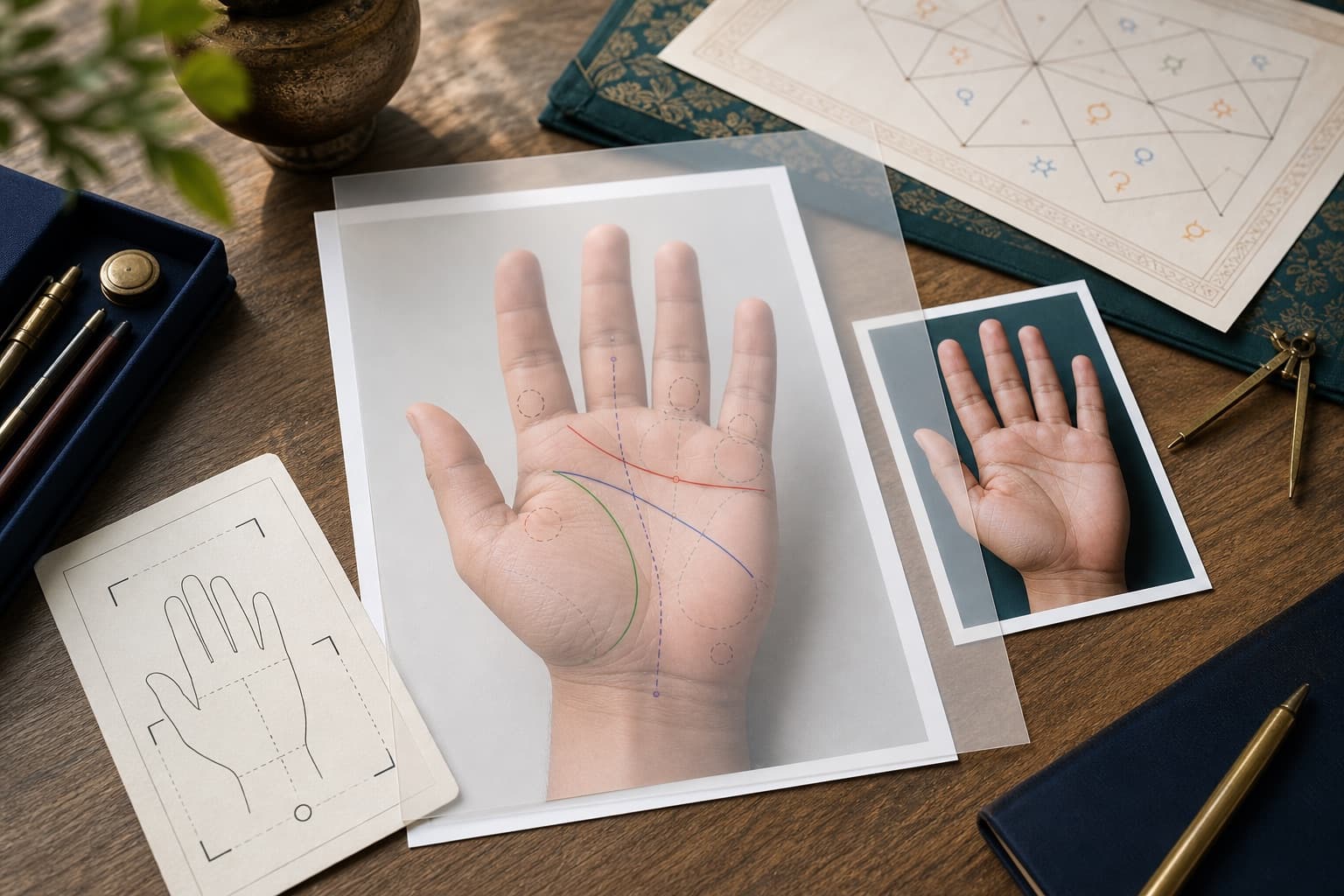
Visual notebook
How to study this lesson
Read the concept, map it onto a real Kundli, then test whether the conclusion follows from chart evidence.
Image first
Step 1Visible reading
Step 2Kundli depth
Step 3Reading recipe
- 1Dominant hand and active pattern
- 2Left and right are viewer-dependent
- 3Orientation and framing
- 4How to compare both hands
Concepts to recognize
Student discipline
Do not memorize this as a fixed prediction. Use it as a method: identify the factor, check condition, compare supporting layers, then write a useful answer.
Dominant hand and active pattern
Many palmistry traditions read the dominant hand as the active, lived pattern: how choices, habits, and present expression are developing. The non-dominant hand may be read as baseline, inherited rhythm, earlier pattern, or background tendency.
If the user is unsure, the system can still read the clearer palm first and label the contrast as tentative.
Left and right are viewer-dependent
A palm-facing right hand usually places the thumb on the viewer's left. A palm-facing left hand usually places the thumb on the viewer's right. Camera mirroring, selfies, rotation, and cropping can confuse simple detection.
That is why the product should combine automatic detection with user controls: rotate, center, fill the guide, and confirm hand side when needed.
Orientation and framing
The best reading frame has fingers up, wrist down, thumb visible, and the palm centered inside the guide. If the wrist or fingers are cut off, line zones can be misread. If the hand is tilted, line direction can look wrong.
A premium product should give correction guidance before generating a weak reading.
How to compare both hands
When both palms are available, compare clarity and continuity of the major lines. If the active hand is clearer than the baseline hand, the person may be expressing the pattern more consciously now. If the baseline hand is clearer, the person may still rely on inherited or earlier rhythms.
Do not present differences as contradictions. Present them as lived pattern versus background tendency.
User-facing language
Instead of showing detected hand, palm score, finger cues, and internal confidence as the main result, say what the user can do: the left photo appears usable, the right photo needs brighter light, rotate the photo so fingers point upward, or confirm whether this is the correct hand.
Related terms
Keep studying
Palm Lines Basics
A complete palmistry foundation lesson on photo quality, major lines, line clarity, mounts, and safe interpretation boundaries.
Study articlePalm Reading and Kundli Together
A product and learning lesson on using palm reading as an immediate visual hook, then inviting Kundli for timing, dasha, and deeper Jyotish context.
Study article