
Palm Lines Basics
A complete palmistry foundation lesson on photo quality, major lines, line clarity, mounts, and safe interpretation boundaries.
Visual notebook
How to study this lesson
Read the concept, map it onto a real Kundli, then test whether the conclusion follows from chart evidence.
Image first
Step 1Visible reading
Step 2Kundli depth
Step 3Reading recipe
- 1Start with the photo, not the meaning
- 2The major lines
- 3Line quality
- 4Mounts and palm shape
Concepts to recognize
Student discipline
Do not memorize this as a fixed prediction. Use it as a method: identify the factor, check condition, compare supporting layers, then write a useful answer.
Start with the photo, not the meaning
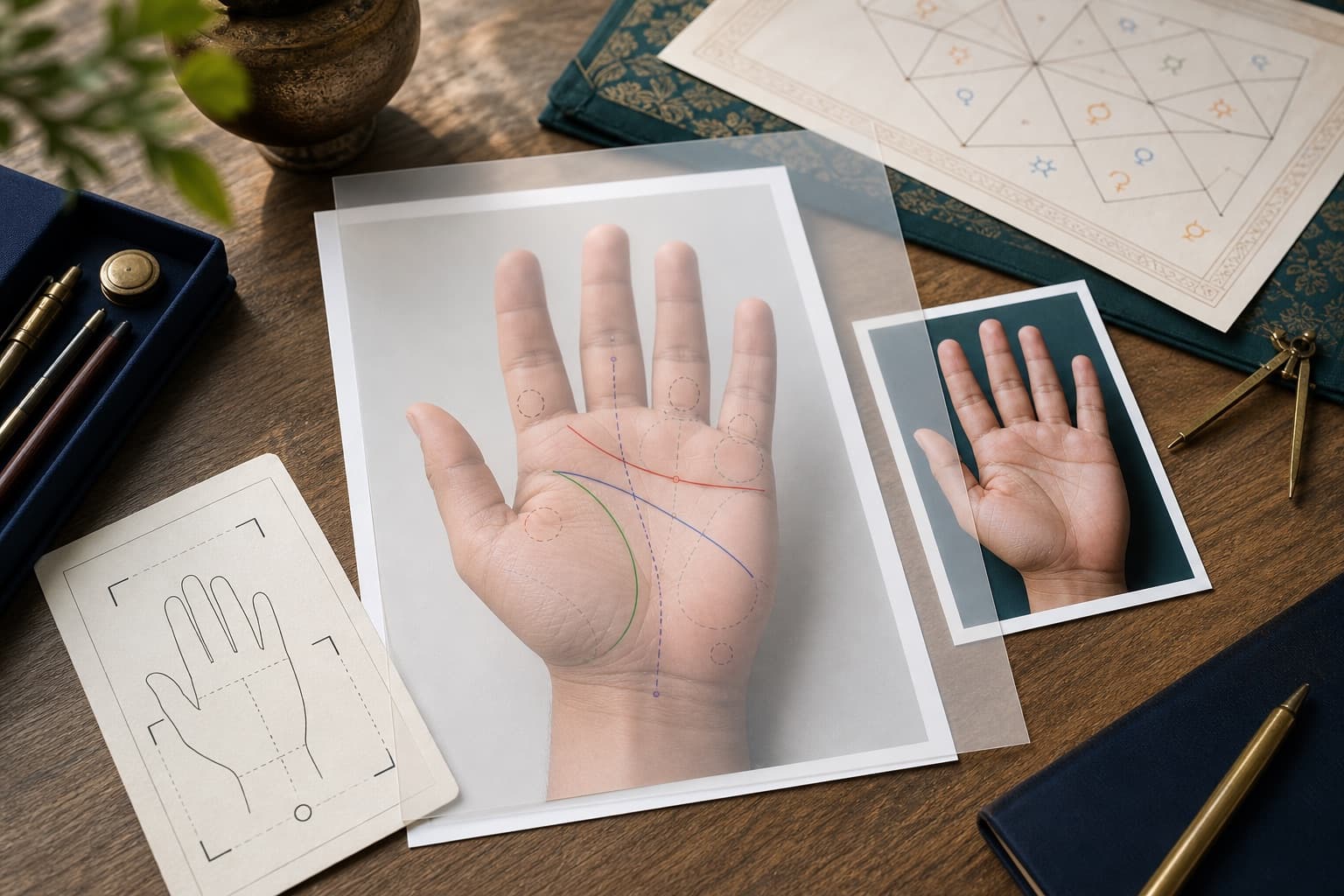
A palm reading is only as good as the image. The palm should be open, fingers up, wrist down, thumb visible, and the hand filling most of the frame. Light should be even, not harsh, and the main creases should be visible without glare.
Screenshots, decorative images, closed hands, side angles, blurred photos, and cropped palms should be rejected or marked as low confidence.
The major lines
The life line curves around the thumb-side base of the palm. It is read for vitality rhythm, pacing, recovery habits, and steadiness, not literal lifespan. The head line crosses the middle of the palm and is read for thinking style, decision rhythm, focus, and planning.
The heart line sits in the upper palm and is read for emotional expression, relationship communication, and feeling style. The fate line, when visible, runs more vertically through the center and is read for work direction, responsibility, and role-building.
Line quality
A line is not just present or absent. Read its quality.
- Clarity: can the line be seen?
- Continuity: does it flow or break?
- Depth: is it strong or faint?
- Direction: is it level, rising, or dropping?
- Intersection: does it cross or join other major lines?
- Symmetry: does the pattern differ between hands?
Mounts and palm shape
Mounts are zones of emphasis, not guaranteed outcomes. Venus mount near the thumb can indicate warmth, stamina, affection, and attachment themes. Moon mount on the outer palm can indicate imagination, travel, sensitivity, and inner life. Jupiter, Saturn, Sun, Mercury, and Mars areas are read as emphasis zones under or around the fingers and palm edges.
Palm shape and finger proportion add temperament context. They should not override clear line evidence.
What not to claim
Palm reading should not diagnose health, predict death, replace professional advice, or make absolute claims about marriage, wealth, fertility, or safety. The right language is reflective: visible habits, current pattern, confidence level, and next step.
Related terms
Keep studying
Left and Right Hands
A structured lesson on dominant hand, baseline hand, left/right detection, orientation, and comparing both palms without confusing the user.
Study articlePalm Reading and Kundli Together
A product and learning lesson on using palm reading as an immediate visual hook, then inviting Kundli for timing, dasha, and deeper Jyotish context.
Study article