
D9 and D10: When Divisional Charts Matter
A deeper lesson on D9 and D10 as refinement charts for maturity, relationship, dharma, career, public work, and planetary strength.
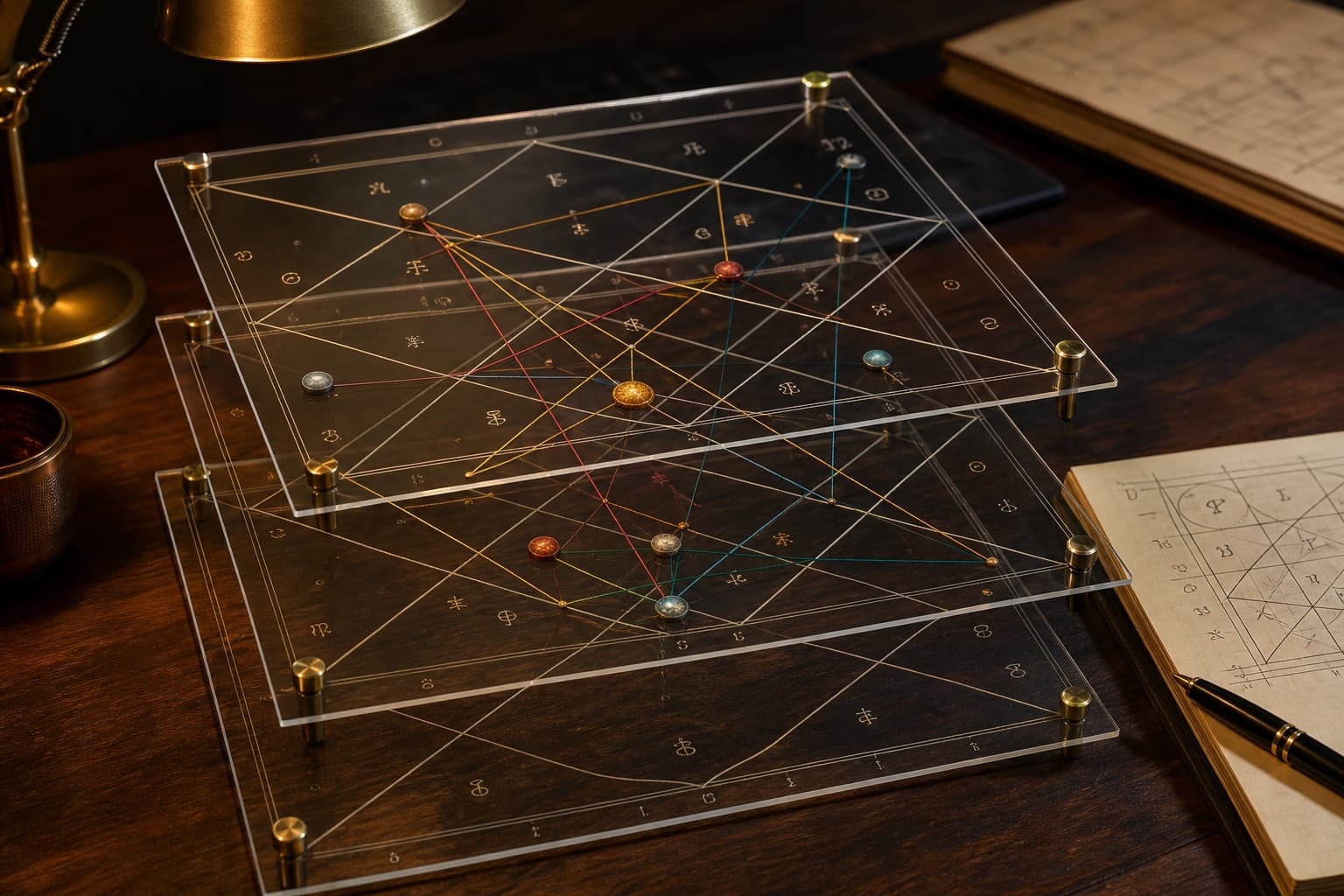
Visual notebook
How to study this lesson
Read the concept, map it onto a real Kundli, then test whether the conclusion follows from chart evidence.
D1 first
Step 1Topic method
Step 2Synthesis
Step 3Reading recipe
- 1The role of divisional charts
- 2D9 Navamsa
- 3D10 Dasamsa
- 4How to compare D1, D9, and D10
Student discipline
Do not memorize this as a fixed prediction. Use it as a method: identify the factor, check condition, compare supporting layers, then write a useful answer.
The role of divisional charts
Divisional charts are derived from the same planetary longitudes but divide signs into finer portions. They give a more focused view of a topic. D9 is often used for dharma, maturity, marriage, and inner strength. D10 is used for career execution, public role, and work responsibility.
The key rule is that divisional charts refine the D1. If a topic is not visible in D1, do not manufacture it from a divisional chart alone.
D9 Navamsa
D9 is not only marriage. It is also about dharma, maturity, values, inner alignment, and the deeper condition of planets. A planet weak in D1 but stronger in D9 may mature with time. A planet strong in D1 but strained in D9 may require inner work or ethical refinement.
For relationship questions, D9 helps refine 7th house themes, Venus/Jupiter indications, commitment quality, and long-term alignment.
- Use D9 after D1.
- Read D9 for maturity and relationship depth.
- Compare important planets across D1 and D9.
- Do not use D9 to override clear D1 evidence.
D10 Dasamsa
D10 refines career, public contribution, execution, reputation, authority, and work responsibility. It is especially useful when D1 career indicators are mixed or when a person asks about role, recognition, leadership, or professional direction.
A strong D10 can show that career expression becomes more coherent when the person works through the right role structure. A difficult D10 may show pressure, delayed recognition, authority friction, or the need for disciplined skill-building.
How to compare D1, D9, and D10
Pick the planet or lord relevant to the topic. For career, compare the 10th lord, Sun, Saturn, Mercury, and current dasha lord across D1 and D10. For relationship, compare the 7th lord, Venus, Jupiter, Moon, and dasha lord across D1 and D9.
Look for repetition. If the same theme repeats across D1 and the relevant divisional chart, confidence rises. If the charts disagree, the reading should describe the tension rather than forcing a simple answer.
Birth-time caution
Divisional charts become more sensitive as the division gets finer. Ascendant-based divisional interpretation especially depends on accurate time. If the birth time is unknown, use divisional claims cautiously and avoid strong predictions from varga houses.
Related terms
Keep studying
How to Read the D1 Chart
A practitioner-style order of operations for reading the D1 chart from whole-chart orientation to topic-specific synthesis.
Study articleAspects, Yogas, and Lordships
An advanced lesson on building classical interpretation from lordship, aspects, conjunctions, yoga validation, and timing activation.
Study article