
North Indian and South Indian Chart Formats
A deep explanation of how the same D1 chart appears in two classical visual traditions and why the display format should not change the calculation.
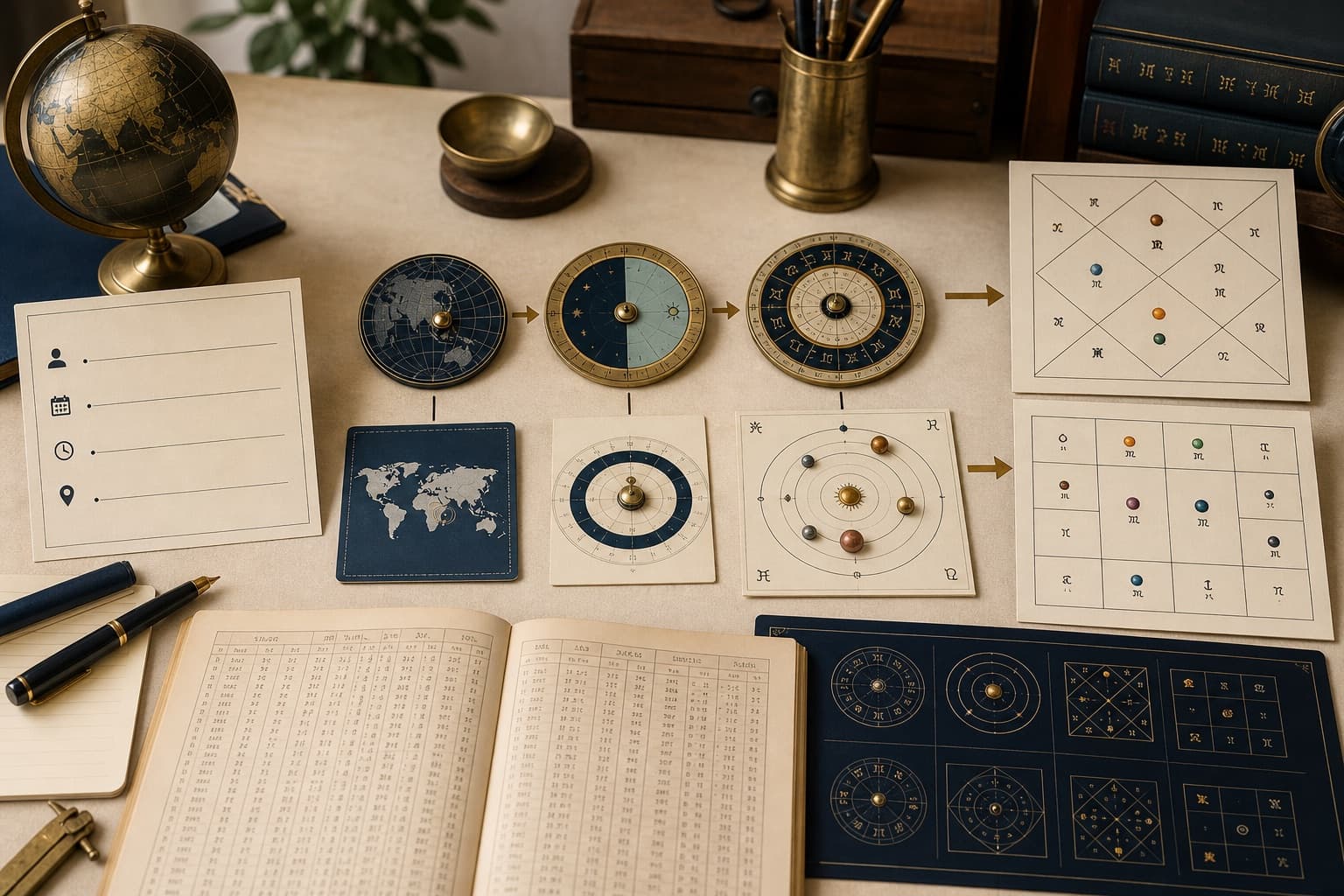
Visual notebook
How to study this lesson
Read the concept, map it onto a real Kundli, then test whether the conclusion follows from chart evidence.
Inputs
Step 1Calculation
Step 2Display
Step 3Reading recipe
- 1One D1, two visual traditions
- 2South Indian format: signs stay fixed
- 3North Indian format: houses stay fixed
- 4How PanditOne keeps the views consistent
Concepts to recognize
Student discipline
Do not memorize this as a fixed prediction. Use it as a method: identify the factor, check condition, compare supporting layers, then write a useful answer.
One D1, two visual traditions
The D1 birth chart is one underlying data set: sidereal signs, planets, Lagna, house numbers, and lordships. North Indian and South Indian charts display that same data differently. If the engine calculates Moon in Cancer house 7, both views should show the same fact, even though the boxes and reading path look different.
This matters for trust. A user should never think the app calculated two different charts. The product should say: both views show the same D1 birth chart; use the format that matches your reading tradition.
South Indian format: signs stay fixed
In the South Indian style, zodiac signs occupy fixed positions in the chart layout. Aries, Taurus, Gemini, and the rest remain in the same visual boxes. The Lagna marker tells the reader where house 1 begins, and houses are counted from that sign.
This format is powerful for readers who think sign-first. You can immediately see which signs contain planets, then trace house meaning from the Lagna. If Capricorn is Lagna, Capricorn becomes house 1 even though Capricorn's visual box is fixed in the South Indian layout.
- Signs are fixed in the visual grid.
- Lagna determines which sign becomes house 1.
- House numbers are counted from Lagna through the signs.
- The reader often thinks sign-to-house.
North Indian format: houses stay fixed
In the North Indian style, the house positions are fixed. House 1, 4, 7, and 10 have stable visual locations, and signs are placed into those houses based on Lagna. This format is powerful for readers who think house-first.
If Capricorn is Lagna, house 1 contains Capricorn, house 2 contains Aquarius, and so on. The visual layout emphasizes life areas immediately: partnership, career, home, and identity can be located by house position before reading sign style.
- Houses are fixed in the visual grid.
- Signs are inserted into houses from the Lagna sign.
- The reader often thinks house-to-sign.
- The same planet cannot move houses merely because the user toggles chart format.
How PanditOne keeps the views consistent
The app builds chart entries by sign and house from the calculated D1 data. The South Indian view displays fixed sign cells and annotates house numbers from Lagna. The North Indian view displays house cells and fills in sign and planet labels from the same D1 entries.
This means the toggle is a display preference. It should not affect dasha, dignity, house lordship, aspects, divisional charts, or compatibility calculations. If a user sees a mismatch, that is a UI or data-mapping issue to audit, not a second astrological calculation.
- D1 placement data is shared.
- South Indian view is sign-fixed.
- North Indian view is house-fixed.
- Interpretation should reference the same house, sign, and planet facts in both.
Reading practice across both formats
Choose one planet and read it in both displays. In South Indian format, find its sign first, then count its house from Lagna. In North Indian format, find its house first, then read the sign inside that house. If both routes do not lead to the same answer, stop and audit the chart data.
This exercise trains a student to separate the chart from the diagram. The diagram is a reading aid. The chart data is the calculation.
Related terms
Keep studying
How the PanditOne Engine Works
A transparent walkthrough of the calculation pipeline from birth data to planets, houses, dashas, divisional charts, and report-ready interpretation signals.
Study articleHow Divisional Charts Are Derived
A practical study of the complete 16-chart Shodashavarga set, from D1 through D60, and how to use calculated varga signs without overclaiming.
Study article