
1
Inputs
Date, local time, timezone, latitude, and longitude become the calculation moment.
Timezone mattersCoordinates matterUnknown time lowers confidence
How it works
Study how PanditOne calculates a chart and renders the same D1 data in South and North Indian formats.
Best for serious students, practitioners, and workspace owners who want to understand what the software is calculating before interpreting it.
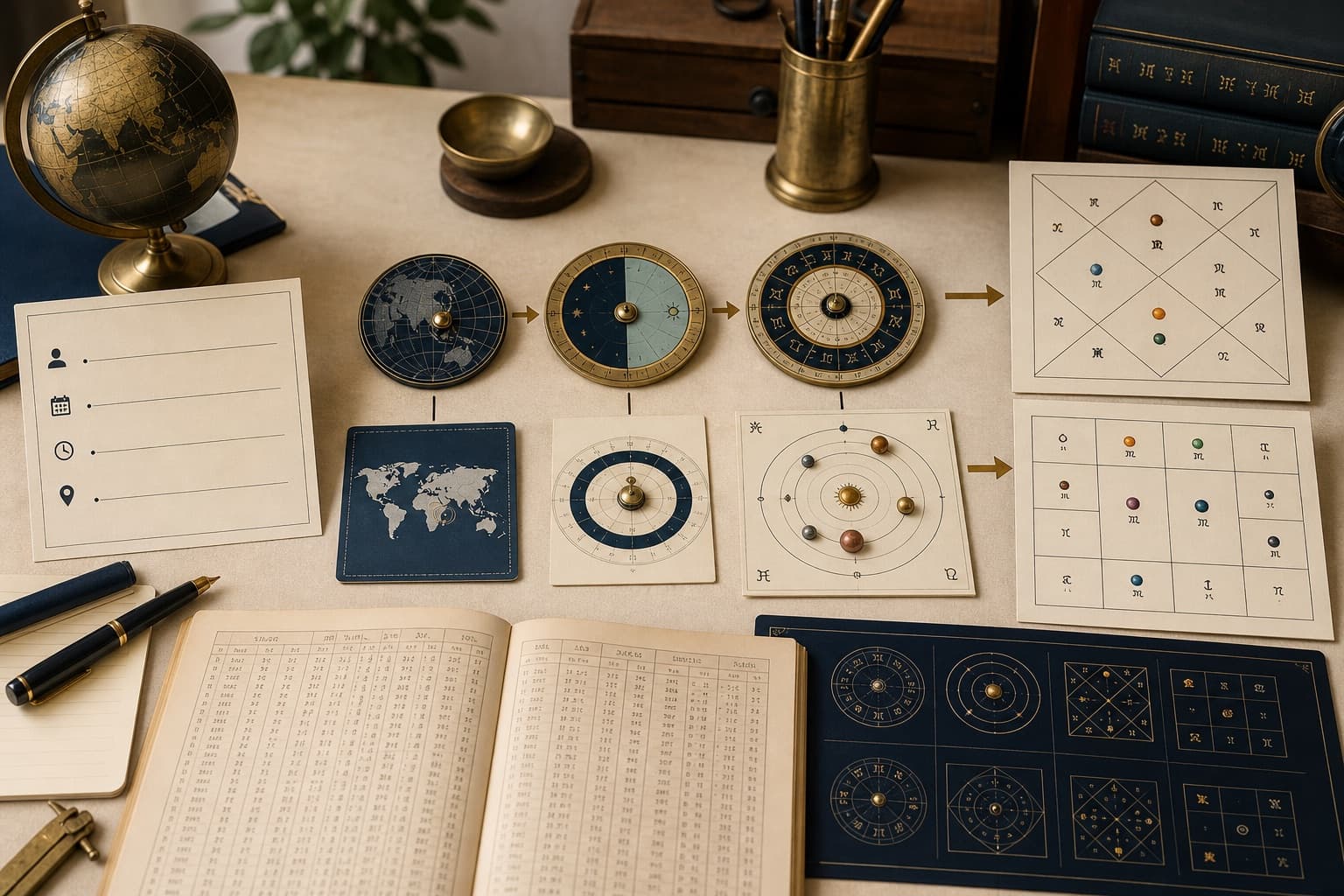
Method board
The engine section teaches how chart data is produced before interpretation, including ayanamsa, house settings, vargas, and chart formats.
Inputs
Timezone matters • Coordinates matter
Calculation
Lahiri-style sidereal frame • Whole-sign Jyotish houses
Display
South: signs fixed • North: houses fixed
Date, local time, timezone, latitude, and longitude become the calculation moment.
Sidereal longitudes, ayanamsa, nakshatras, houses, dashas, and vargas are derived before interpretation.
North Indian and South Indian charts render the same D1 data through different visual traditions.
A transparent walkthrough of the calculation pipeline from birth data to planets, houses, dashas, divisional charts, and report-ready interpretation signals.
Study articleA deep explanation of how the same D1 chart appears in two classical visual traditions and why the display format should not change the calculation.
Study articleA practical study of the complete 16-chart Shodashavarga set, from D1 through D60, and how to use calculated varga signs without overclaiming.
Study articleA practitioner-grade checklist for validating calculation output, reviewing warnings, and turning technical data into credible guidance.
Study articlePractice with your chart
Use what you learned, then open your Kundli to see the same concepts applied to your Lagna, Moon, dashas, and houses.