
How the PanditOne Engine Works
A transparent walkthrough of the calculation pipeline from birth data to planets, houses, dashas, divisional charts, and report-ready interpretation signals.
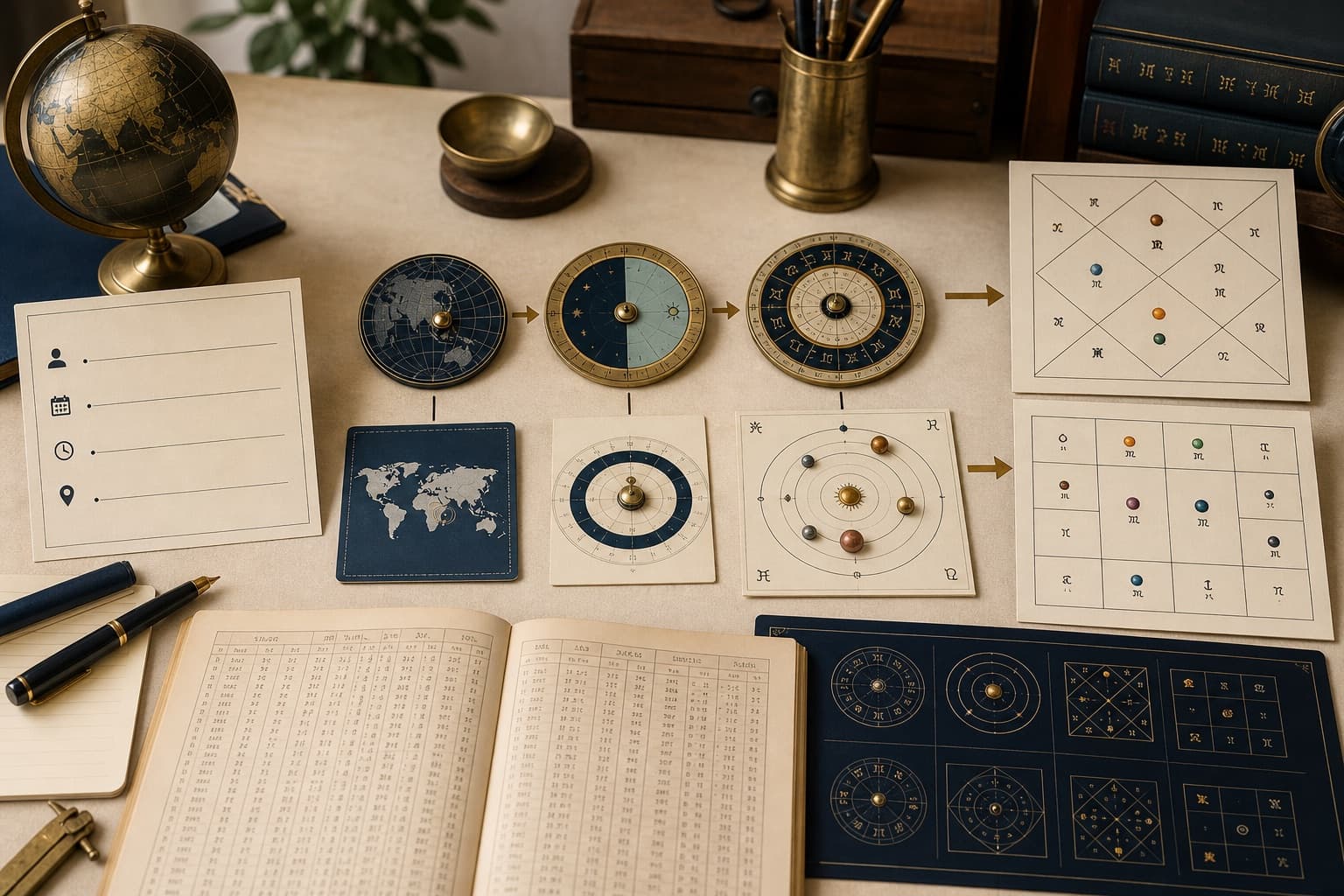
दृश्य नोटबुक
इस पाठ का अध्ययन कैसे करें
अवधारणा को पढ़ें, इसे वास्तविक कुंडली पर अंकित करें, फिर परीक्षण करें कि निष्कर्ष चार्ट साक्ष्य से मिलता है या नहीं।
इनपुट
कदम 1गणना
कदम 2प्रदर्शन
कदम 3नुस्खा पढ़ना
- 1चरण 1: जन्म डेटा गणना क्षण बन जाता है
- 2चरण 2: उष्णकटिबंधीय आकाश स्थितियों को नक्षत्र ज्योतिष स्थितियों में परिवर्तित किया जाता है
- 3चरण 3: लग्न से लग्न और मकान का निर्माण किया जाता है
- 4चरण 4: व्याख्या परतें निकाली जाती हैं लेकिन उन्हें समझाने योग्य रखा जाता है
पहचानने योग्य अवधारणाएँ
विद्यार्थी अनुशासन
इसे एक निश्चित भविष्यवाणी के रूप में याद न रखें। इसे एक विधि के रूप में उपयोग करें: कारक की पहचान करें, स्थिति की जांच करें, सहायक परतों की तुलना करें, फिर एक उपयोगी उत्तर लिखें।
चरण 1: जन्म डेटा गणना क्षण बन जाता है
The engine begins with date, local time, timezone, latitude, and longitude. The local birth moment is converted into a universal calculation moment, recorded as Julian Day UT. This is important because planetary positions are time-dependent and because the same clock time means different sky moments in different timezones.
If time, place, or timezone is missing, the engine can still show some broad signs, but it should lower confidence for houses, Lagna, divisional charts, and timing-sensitive interpretation. A professional reader should always ask whether the birth time is exact, approximate, or unknown before treating house-based claims as strong.
- Date and time establish the moment.
- Timezone converts local clock time into universal time.
- Latitude and longitude allow the ascendant and house sequence to be calculated.
- Calculation warnings should be treated as interpretation limits, not ignored.
चरण 2: उष्णकटिबंधीय आकाश स्थितियों को नक्षत्र ज्योतिष स्थितियों में परिवर्तित किया जाता है
The engine calculates observable planetary positions and then converts them into sidereal longitudes by subtracting ayanamsa. The calculation profile is sidereal-primary with tropical data retained only as secondary audit context. The default ayanamsa path is Lahiri unless another supported setting is explicitly supplied.
This is why a professional report should list ayanamsa degrees. Without that, two readers using different settings may disagree by enough to change a nakshatra, pada, or divisional placement near a boundary.
- Tropical longitude is the astronomy-facing position.
- Ayanamsa converts tropical longitude into sidereal longitude.
- Sidereal longitude determines sign, degree, nakshatra, pada, dignity, and varga signs.
- Boundary cases require extra caution.
चरण 3: लग्न से लग्न और मकान का निर्माण किया जाता है
After the ascendant is resolved, the engine assigns the first house to the ascendant sign and derives the house sequence from there. The current chart profile uses whole-sign style house logic for the Jyotish reading surface, so every sign becomes one house beginning from Lagna.
This makes the chart easier to audit: if Lagna is Capricorn, Capricorn is house 1, Aquarius is house 2, Pisces is house 3, and so on. The South Indian and North Indian displays may look different, but the house assignments are the same underlying D1 data.
- Lagna starts the house sequence.
- Whole-sign logic keeps each sign aligned to one house.
- An empty house is still readable through sign lord, aspects, karakas, and timing.
- House conclusions depend heavily on accurate birth time.
चरण 4: व्याख्या परतें निकाली जाती हैं लेकिन उन्हें समझाने योग्य रखा जाता है
Once planets, Lagna, houses, and vargas are available, the engine derives nakshatra, pada, dignity, sign lord, house lordships, aspects, panchanga, Vimshottari dasha, transits, and classical pattern signals. These are not all equal in interpretive weight.
A premium report should tell the user which factors are calculation facts and which are interpretive emphasis. For example, Moon in a nakshatra is a calculation fact. Relationship focus being supportive or mixed is an interpretation built from multiple facts.
- Calculation facts: longitude, sign, house, nakshatra, varga sign, dasha dates.
- Derived technical factors: dignity, aspects, lordships, panchanga, dosha flags.
- Interpretive output: strengths, challenges, timing guidance, remedies, next steps.
- Good learning material teaches the difference.
चरण 5: सत्यापन और अंशांकन विश्वास की रक्षा करते हैं
The engine records calculation source, ephemeris provider, ayanamsa, house system, node mode, and warnings. This is not internal trivia. It is what lets a student or practitioner audit the chart when a placement looks surprising.
The product should avoid pretending that every output is equally certain. A high-quality reading is transparent: it names its settings, admits limits, and explains why a conclusion follows from chart factors.
संबंधित शर्तें
पढ़ते रहो
उत्तर भारतीय और दक्षिण भारतीय चार्ट प्रारूप
A deep explanation of how the same D1 chart appears in two classical visual traditions and why the display format should not change the calculation.
लेख पढ़ेंसंभागीय चार्ट कैसे निकाले जाते हैं
A practical study of the complete 16-chart Shodashavarga set, from D1 through D60, and how to use calculated varga signs without overclaiming.
लेख पढ़ें