
How to Read the D1 Chart
A practitioner-style order of operations for reading the D1 chart from whole-chart orientation to topic-specific synthesis.
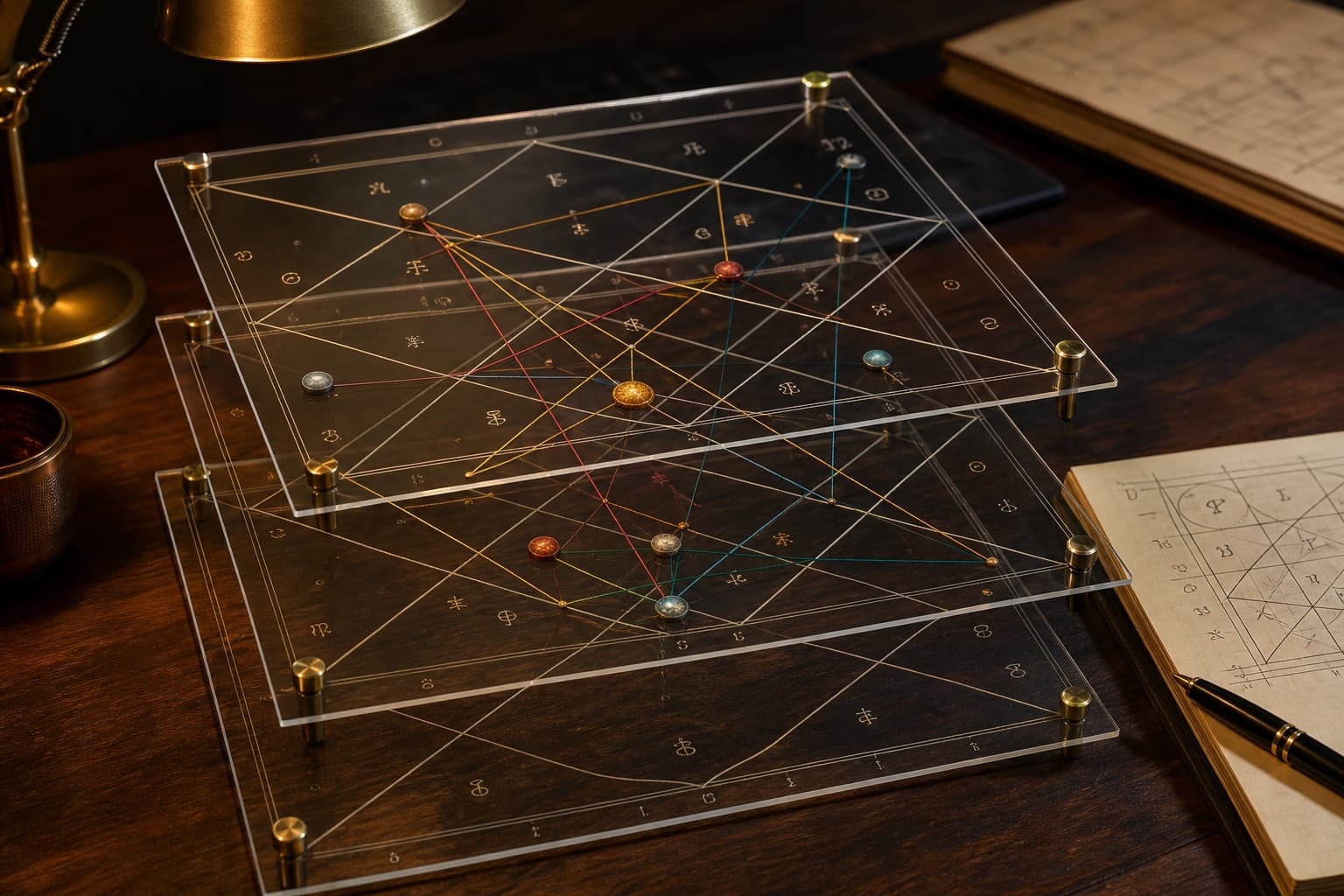
Visual notebook
How to study this lesson
Read the concept, map it onto a real Kundli, then test whether the conclusion follows from chart evidence.
D1 first
Step 1Topic method
Step 2Synthesis
Step 3Reading recipe
- 1Why D1 comes first
- 2The full-chart scan
- 3The house method
- 4Planet condition and functional role
Concepts to recognize
Student discipline
Do not memorize this as a fixed prediction. Use it as a method: identify the factor, check condition, compare supporting layers, then write a useful answer.
Why D1 comes first
The D1 Rashi chart is the main life map. It gives the Lagna, house sequence, planetary sign placements, house lordships, and the broad structure of life themes. Divisional charts are valuable, but they refine the D1; they do not replace it.
A common beginner mistake is to jump into D9 or a yoga list before understanding the D1. This creates disconnected interpretation. A professional reader first asks: what is the main chart saying?
The full-chart scan
Begin with a whole-chart scan before answering any specific question.
- Lagna sign and Lagna lord condition.
- Moon sign, nakshatra, house, and lord.
- Sun sign, house, and dignity.
- Most occupied houses.
- Angular houses and trines.
- Current Mahadasha and Antardasha.
- Planets that are exalted, debilitated, own-sign, combust, retrograde, or heavily aspected.
The house method
For any topic, read the house in five passes: sign in the house, planets in the house, house lord placement, aspects to the house or lord, and relevant karakas. This is the minimum method for avoiding weak interpretation.
For example, career is not only the 10th house. It includes the 10th house, 10th lord, Sun, Saturn, Mercury, D10, the 6th for work routines, the 2nd and 11th for income, and current dasha.
Planet condition and functional role
A planet has natural meaning, but its functional role depends on Lagna. A natural benefic can rule difficult houses. A natural malefic can rule highly important houses. Read the planet's dignity and functional ownership together.
This is why generic statements fail. Saturn is not simply bad, and Jupiter is not simply good. The chart asks: what does this planet rule, where is it placed, how strong is it, and what does timing activate?
Synthesis before conclusion
After collecting indicators, decide whether they agree, conflict, or require timing. If several indicators point to the same theme, confidence rises. If indicators conflict, the interpretation should say what is supported and what needs care.
A good final answer includes opportunity, caution, timing, and next step. It does not merely list placements.
Related terms
Keep studying
D9 and D10: When Divisional Charts Matter
A deeper lesson on D9 and D10 as refinement charts for maturity, relationship, dharma, career, public work, and planetary strength.
Study articleAspects, Yogas, and Lordships
An advanced lesson on building classical interpretation from lordship, aspects, conjunctions, yoga validation, and timing activation.
Study article